
SV in Denial: Consequences of
Unnatural
Canine Structure and Type
Jim Engel
The cardinal principle of Max von Stephanitz, founder of the German Shepherd, is that form must follow
function, that the correct structure is that which enables these noble dogs to engage in long and
effective careers in police or military style service. Those following in the footsteps of the
founder— breed this dog and guide the SV—must be evaluated according to how they carry forward
this heritage. Over recent decades the SV and the show breeders have incessantly abandoned this
culture in favor of increasingly grotesque fashion, leading to the decline of the breed in police
service and increasing susceptibility to career ending back injury. We know this very well because
of ongoing experience and because the SV itself is setting up a medical screening program in an attempt to
remedy endemic defective structure in the back.
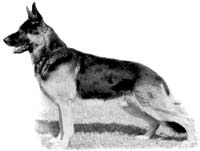
Bernd vom Kallengarten
Responsible caution is always appropriate in such matters; speculation on causative factors of disease, susceptibility to injury or physical disability without the discipline of scientific statistical analysis and peer review methodology can lead to false science, malevolent pseudo-scientific mythology creating misinformation and anguish for those who become afflicted. A prime example has been speculation of common childhood vaccinations as a causative factor in autism, where serious lapses on the part of one or two scientists and journal editors has resulted in lay people assuming the role of expert crusader leading to enormous confusion, elaborate conspiracy theories and serious damage to innumerable children. The choice to abstain can lead to unnecessary exposure far beyond the individual child, a serious danger to other vulnerable children. This is because vaccination not only protects the individual it also if widely enough applied can diminish or eradicate a disease such as polio or small pox.
Scientific progress typically comes through an accumulation of anecdotal observations, the emergence of speculative theories and then organized observation and studies in support of statistical analysis, which may either establish or discredit the original thesis. A half century ago speculation of hip dysplasia as a cause of observed crippling and disability in dogs became increasingly widespread. Many breeders and owners pushed back— were in denial— fearful of the loss of important elements of breeding programs, sometimes the work of a lifetime. Eventually the evidence became overwhelming and hip dysplasia has come to be taken very seriously.
Over the years the incidence of serious back defects leading to early retirement of prominent German Shepherd working competitors has been a cause of concern, comment and speculation. It is of course only normal caution and common sense to note that such occurrences will be widely discussed and remembered over many years while other unknown dogs in family situations, back yards or kennel runs may very well experience a similar or even greater rate of affliction, or may never be afflicted at all because they are not subjected to the strenuous exercise of training and competition. We must always remember that correlation does not in and of itself prove causation, but rather is an indication of a need for further investigation.
But the fact remains that there has been persistent and increasing speculation as to a genetic causative factor for these debilitating back injuries, which takes on credibility and urgency with the appearance a provocative article in the SV journal entitled Lumbar-Sacral Transitional Vertebrae (LTV) and the institution of a formal LTV certification process similar to the hip dysplasia program. Although we are not privy to the details of the process leading up to this it clearly indicates that the SV finds the statistical data and supporting evidence compelling. The new LTV medical screening is optional at the moment but a formal requirement for SV registration would appear to be imminent; the Germans seem to be taking this very seriously. SV Article
The long term ramifications are most serious in that it is increasingly difficult to evade the conclusion that breeding selection for extreme angulation and exaggerated slope in the back is the primary causative factor of these endemic spinal defects and the crippling of so many relatively young German Shepherd dogs. There are some who say that perhaps this may be a matter of a few breeding programs, highlighted by a prominent series of somewhat related afflicted working dogs in America. But just as hip dysplasia came to attention through its appearance in particular lines, often deeply inbred, ultimately it came to be seen for what it is, a serious underlying systemic genetic affliction.
Structure and stride
In order to more fully grasp the ramifications of these developments it is useful to look to our history of domestication and our propensity to genetically manipulate these animals according to our own ends. Many species or breeds such as cats, horses and various canine breeds easily revert to the wild, are similar enough to the founding progenitors to provide for themselves in a natural environment. Others such as most dairy cattle and many canine breeds such as English or French Bull Dogs would most likely perish if returned to the wild. This genetic manipulation in dairy cattle serves a useful and rational purpose, enormously increases milk production. The purposeful grotesque modification of many canine breeds such as the extremely narrow head of the English Collie or the foreshortened muzzle of the Boxer creates animals that are unfit and live less fulfilling and less healthy lives even in domestication, let alone a wild setting. This is grossly irresponsible and immoral, blatant animal abuse as despicable as pit fighting and bear baiting. Unfortunately, the extremes in angulation and back slope currently fashionable in the German Shepherd have risen to this level of abuse, are by any objective criteria immoral and irrational, seriously threatening viable service in the historic police and military roles.
The canids—including dogs, wolves, coyotes, foxes, jackals, and dingoes—are large and successful medium to larger size predators, often hunting and living in packs or smaller groups as opposed to the big cats, who with the notable exception of the lion tend to live solitary lives except for brief mating encounters. As would be expected there is a general similarity of physical structure adapted to predators such as a wolf needing to cover distance efficiently in diverse and often rough terrain, agile enough to bring down larger prey species such as deer and elk without life limiting injury. On the one hand the general physical prototype of the feline species is entirely different because the cats are sprinters, creep to within a short distance of their prey and then make an all or nothing sprint. The canine on the other hand normally will pursue over great distance. Natural selection has evolved these entirely different but extraordinarily effective structures over millions of years, and it is unwise and irresponsible to radically alter this through breeding selection for mere fashion.
Thus as would be expected, we see a general commonality of structure and type among wolves, coyotes, dogs, and the others with minor adaptations according to local environment and conditions. Since the aggregate Canine range covers most of the world except Antarctica, physical form ranges from the relatively massive northern timber wolf preying on elk and other large mammals, the smaller, more agile less bulky coyote hunting smaller game, often alone, to petite and almost frail large eared desert foxes. But when you look closely the underlying structure in terms of relative back length and slope, angulation and general form they are all quite similar. Nature has evolved a very efficient, effective and durable structure for these longer distance covering predators adaptable to diverse prey species and environments. It cannot be in any way surprising that substantially deviating from this basic prototype in unnatural ways will ultimately result in reducing performance aspects such as speed and agility and lead to a propensity to genetically related injury.
Looking back to the turn of the twentieth century when the shepherd's dogs of Germany, Belgium and Holland were being gathered from the fields and formed into breeds there was great physical similarity. Given a table covered with photos of the era from the various nations and districts it would often be difficult to identify a particular dog as to nation of origin. Although these dogs are not believed to be especially genetically closely related, similar function and environment naturally evolved into a very similar physical type.
But a century later the German Shepherd structure is radically different, has been purposely evolved into a unique, unnatural form with no easily identifiable counterpart in nature. The Dutch and Belgian shepherds on the other hand still retain much of the original form; still have a structure similar to the common ancestral canid prototype.
Clearly under SV guidance the breed finds itself down a blind alley, is more and more selecting for dogs with physical structure rendering them less agile, less able to cope with rougher terrain and in particular much less durable than the historical norm. The incessant process of selecting for extreme side gate and angulation, the banana backed profile, has been to the end of a fashionable long stride side gate to the detriment of the agility and durability so necessary in police and military service. Von Stephanitz, whose motto was form must follow function, would be appalled and ashamed, as should be the SV leadership. Perhaps Heinrich and the boys will regard such references to von Stephanitz as quaint, irrelevant mythology for the young, idealistic and naive, surely not relevant to sophisticated, money making men of the world such as themselves. But perhaps there are still a few in Germany, I know at least two in Holland, who still take working character and structure seriously, regard this as part of our cultural heritage.
This is a crisis, and the question is whether these Germans will be able to connect the dots, perceive that their extreme breeding is having the naturally expected consequences, is in fact the primary causative factor of injury and disability in so many young dogs subjected to the physical exertion of serious training and service. Just as many were reluctant to face up to hip dysplasia fifty years ago, there will no doubt be the tendency to go into avoidance and denial of the real world consequences of the grotesque, unnatural structure that has been so foolishly created.
The only responsible course open to the SV is to radically modify their selection criteria, to return to a much more durable and functional physical type according to the ancestral canine prototype. This is their obligation, necessary to preserve this legacy, to show respect for the work of the founders and generations of ongoing working breeders and trainers.
The moment of truth is at hand.
Jim Engel, Marengo © Copyright March 28, 2018
Link to the SV article:
Lumbar-Sacral Transitional Vertebrae (LTV)Other References:
Degenerative Lumbosacral StenosisLumbosacral Transitional Vertebra In the Dog
Transitional lumbosacral vertebral anomaly in the dog: a radiographic study
Recent articles of interest:
Forty Years of Subservience and StagnationCarmine Battaglia: End of an Era
End of the Beginning?
Style and Opinion Sports
Glossary of Organizations and Abreviations