
The Decline in German Sieger Show Entries and Puppy Registrations (2006–2025)
Louis Donald
Some may see this as negative, twist it to suggest it's a blame game, that the subject matter is best kept quiet, out of public view, left to the experts to deal with. However, I see it as a wake-up call, a clear signal for those in charge to act and nothing gets done when it's only discussed in a closed-door room and too often with people who are in part or whole the problem, but don't see it!
For nearly two decades, both German Sieger Show entries and German puppy registrations have been in steady decline. Anyone with a basic grasp of business knows the danger of a downward trend line. Think of the graph trend line as a plane in a nose-dive, without pilot intervention, the outcome is inevitable.
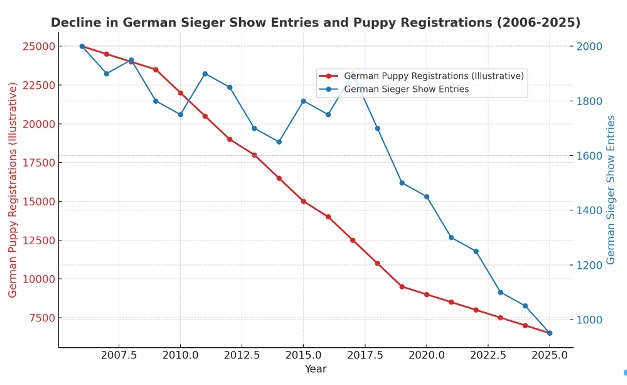
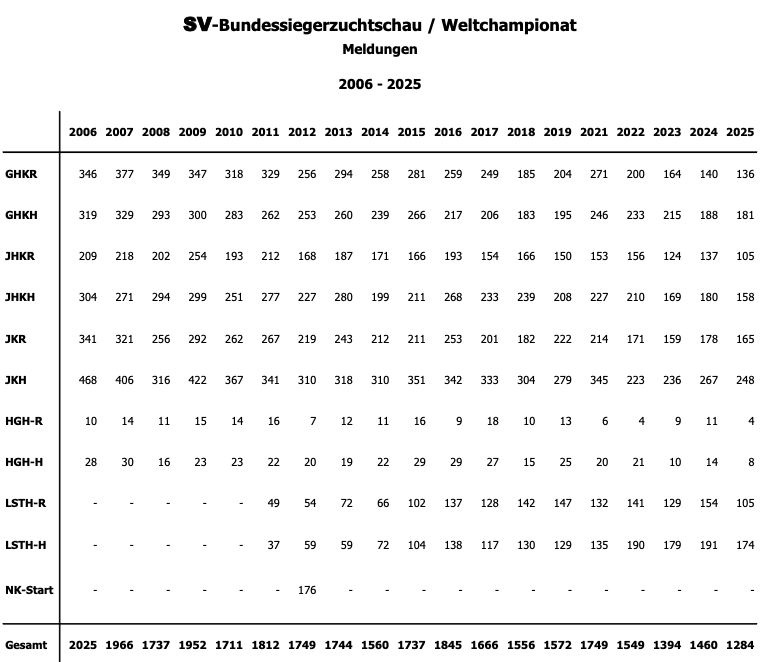
In 2006, the SV-Bundessiegerzuchtschau drew 2,025 entries. By 2025, that number had fallen to 1,284. Key classes have been hit particularly hard:
GHKR: 346 down to 136
GHKH: 319 down to 181
JHKR: 209 down to 105
Puppy registrations, meaning less matings, tell the deeper story. They have dropped from over 24,000 to around 7,000 in the same period. While short-term factors like COVID can create spikes or dips in show entries, registrations reveal the long-term problem: fewer dogs are being bred, with fertility affected by inbreeding depression playing its part too.
If this trajectory continues, the consequences for the breed, the sport, and even the SV itself could be irreversible. Contributing factors include declining public support for the breed due to a myriad of reasons, one being cost, reduced participation by breeders and exhibitors, and management decisions, particularly regarding anatomical construction, that have a detrimental impact on the dog's health and/or well-being.
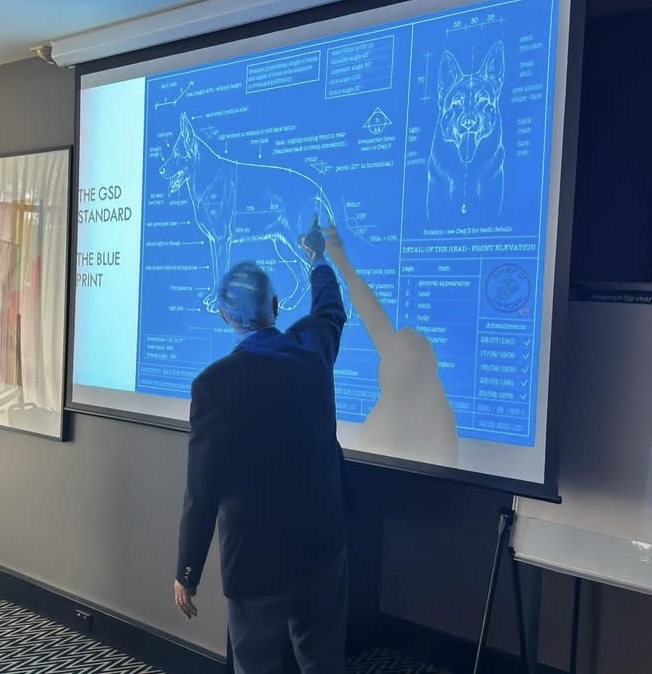
The recent GSDCA lectures in Sydney were a positive step forward, where judges and breed surveyors discussed issues such as overangulation of the hindquarter, the effects of inbreeding depression and weakening character, but the challenge is global and so must be the solution. The SV should lead an international seminar, as occurred under the guidance of its then president, Professor Dr Messler, in Lerma, Spain, to openly address these issues and seek solutions.
The message is clear: the breed is on a downward trend, and it will not correct itself. Those in charge, whether in the SV, national bodies, or judging positions, must confront the reality, accept responsibility, and act. Yes, there are many things beyond their control. We all know what they are: costs for this and that, Council and Government legislations, more people living in apartments, anti-dog groups, and the list goes on. But it means addressing those issues that are within their control and influence. This involves setting priorities based on the breed standard, health, and sustainability, rather than personal preference, which is often influenced by an attraction to exaggeration of form and short-term popularity. Decisions must be transparent, evidence-based, and aimed at reversing this decline, not just managing it.
Too often we hear the line, “every breed is in decline”, delivered as if it excuses doing nothing. It’s a comfort phrase that sidesteps the real question: why is our breed losing ground, and what will we do about it? The truth is, not every breed is in decline. Some small companion breeds are growing. Designer crosses are booming. A major Kennel Club study in the UK shows breed popularity shifts vary sharply, proving that solutions must be tailored to each breed’s situation.
I love analogies: Think about what’s happening in the tech world. AI is automating work that once kept thousands of programmers employed. The ones who survive are learning new skills, moving into AI-related roles, or reshaping what they offer. The ones who don’t adapt are out of a job. They can blame the trend, but it won’t change the outcome.
Breed clubs face the same choice. We can sit back, repeat the excuse that “everyone is struggling,” and let the decline run its course. Or we can face the facts, accept accountability comes with the badge, understand why this is happening, make corrections where we can and as required and adapt before it’s too late. Decline isn’t inevitable — unless we choose to let it be.

Jim Engel Commentary
These thoughts of Mr Donald very much reflect my own as expressed in length here:
Decline and Fall of the House of von Stephanitz
Orginizations and Conflicts
SV Power Corrupts
German Shepherd History
GSD Police Dog Heritage Repudiated by SV
Canine Discipline in the Animal Rights Era
SV Abandons Schutzhund as Breeding Prerequisite
World Unions Rising
AWDF, Stillborn American Elite
Supreme Authority of the Canine World?
Legacy Lost, the Other Breeds
The Americans
Glossary